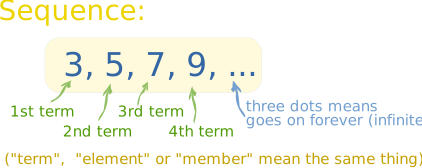
In mathematics, a sequence is an ordered list of objects. Like a set, it contains members (also called elements or terms). The number of ordered elements (possibly infinite) is called the length of the sequence. Unlike a set, order matters, and a particular term can appear multiple times at different positions in the sequence.
AND NOW !
A sequence,
in mathematics, is a string of objects, like numbers, that follow a
particular pattern. The individual elements in a sequence are called terms. Some of the simplest sequences can be found in multiplication tables:
- 3, 6, 9, 12, 15, 18, 21, …
Pattern: “add 3 to the previous number to get the next number” - 0, 12, 24, 36, 48, 60, 72, …
Pattern: “add 12 to the previous number to get the next number”

1, 4, 7, 10, 13, 16, 19, 22, 25, ...
This sequence has a difference of 3 between each number.
The pattern is continued by adding 3 to the last number each time, as shown above
3, 8. 13, 18, 23, 28, 33, 38, ...
This sequence has a difference of 5 between each number.
The pattern is continued by adding 5 to the last number each time, like this:

Question :
1. Find the common difference?
18,26,34,40
20,35,50,?65,80
3. Here is a number pattern. What is the missing number?
63, 55, 47, ? , 31, 23

Great! now I understand. :)
ReplyDelete